
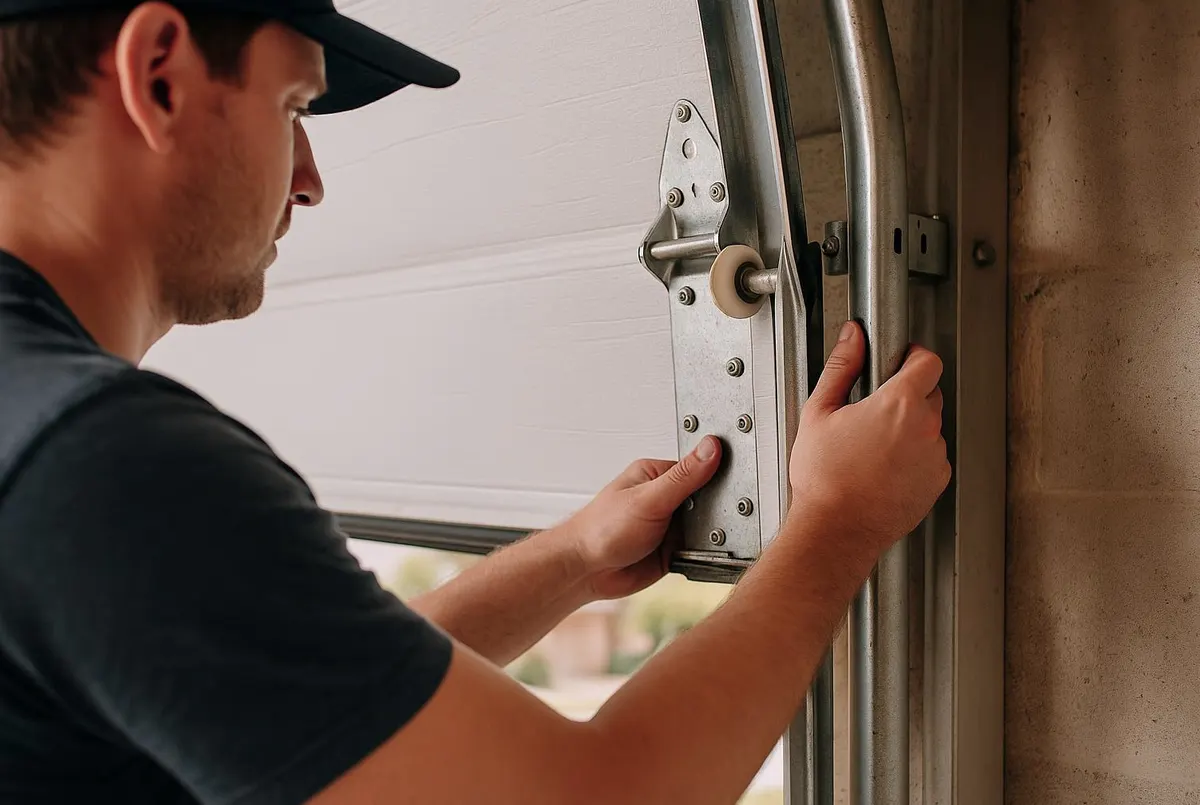
The Cost of Waiting This One Out
A garage door that won't open isn't just an inconvenience you can work around for a few weeks. If it's stuck closed, you're parking on the street through the first ice storms of the season, scraping windshields instead of pulling straight out. If it's stuck open, you've got a wide-open entry point into the house sitting there through cold nights and wind. And if you or someone in the house tries to force it — yanking on the door, hitting the opener button repeatedly, prying at the track — a simple fix can turn into a bent track, a burned-out motor, or a snapped cable that costs far more to repair than the original problem ever would have.
Garage doors in this part of Illinois take a real beating from the seasonal swings: ice and road salt eat at hardware through winter, humidity swells wood framing in summer, and spring storms bring power surges and outages that trip breakers and confuse openers. A door that suddenly won't budge is usually telling you something specific. Here's how a technician works through it.
What You're Actually Seeing
Before any diagnosis, it helps to know which symptom you have, since each points down a different path:
- Nothing happens at all — no light, no motor sound, no movement.
- The opener hums or clicks but the door doesn't move.
- The door opens a few inches, then stops or reverses.
- The door is heavy, won't move by hand either, and looks like it's sagging on one side.
- The opener light blinks a set number of times when you press the button.
Each of these narrows the search considerably — which is why a technician checks causes in a specific order rather than guessing.
1. Power First
Before touching any hardware, check whether the opener is actually getting power. Garage outlets are frequently on a GFCI circuit, and those trip easily — a spring storm with a power flicker, a humid day with a damp outlet, or a space heater sharing the circuit can all do it. Check the outlet, check the breaker panel, and check for a battery backup unit on the opener itself, since those batteries weaken over a few years and often fail right when winter draws more power from the system.
What the fix involves
Usually nothing more than resetting a breaker or GFCI button, or swapping a backup battery. If the outlet is dead even after a reset, that's an electrical issue outside the garage door system and worth a separate look.
2. The Remote and Wall Control
Next is the simplest possible failure: dead batteries in the remote, or a wall control panel that's lost its connection to the opener after a power outage. If one remote works but another doesn't, it's almost always batteries or a programming issue, not the door itself.
What the fix involves
New batteries, or a quick reprogram of the remote to the opener's learn button. Takes a few minutes.
3. Safety Sensors
If the opener runs but the door won't close, or reverses immediately, the photo-eye sensors near the bottom of the track are the next stop. These need a clear, aligned line of sight to each other. Fall debris, a shifted storage bin, a spider web, or sensors knocked slightly out of alignment during cleaning or a bump from a bike or lawn equipment will all trigger this.
What the fix involves
Wiping the sensor lenses, clearing anything in the beam path, and realigning the sensors so both indicator lights are solid rather than blinking.
4. The Manual Release
If the door won't respond to the opener at all but the opener itself seems to be working, check whether the emergency release cord has been pulled and the trolley is still disconnected from the carriage. This happens more often than people expect — during a power outage, someone pulls the cord to open the door by hand and forgets to reconnect it.
What the fix involves
Reconnecting the trolley to the carriage, which is usually just a matter of pulling the release arm back and letting the opener re-engage on the next cycle.
5. Springs and Cables
If the door is heavy, won't lift by hand, or looks crooked or dropped on one side, this is a springs-and-cables issue, and it's the most serious item on this list. Torsion and extension springs wear out from the sheer number of open-close cycles, and cold weather makes the metal more brittle, which is why broken springs show up more often in winter. A snapped cable will often show up alongside a sagging door.
What the fix involves
Spring replacement is not a do-it-yourself repair — these springs are under heavy tension and have injured plenty of confident homeowners. A technician matches the replacement spring to the door's weight and cycle life, and checks cables and drums at the same time since they wear together.
6. Track, Gears, and Limit Settings
Last on the list because it's the least common cause: a bent track from a vehicle bump or winter ice buildup, a stripped gear inside the opener after years of use, or limit settings that have drifted so the opener thinks the door is already at its stopping point.
What the fix involves
Track straightening or replacement, an opener gear or motor repair, or a simple adjustment to the opener's travel limits.
When to Call Kane Garage Door
If you've checked power and the remote and the door still won't move, or if it's heavy and sagging, stop troubleshooting and call. A dropped door or a broken spring is a safety issue, not a weekend project. Kane Garage Door handles Spring Replacement and general Garage Door Repair throughout the Kane, IL area, and offers Emergency Garage Door Service for doors stuck open or closed when you can't wait for a scheduled visit.
If your door won't open and you're in Kane, Jerseyville, Grafton, or the surrounding area, call Kane Garage Door today and get it diagnosed before winter adds another variable to the problem.